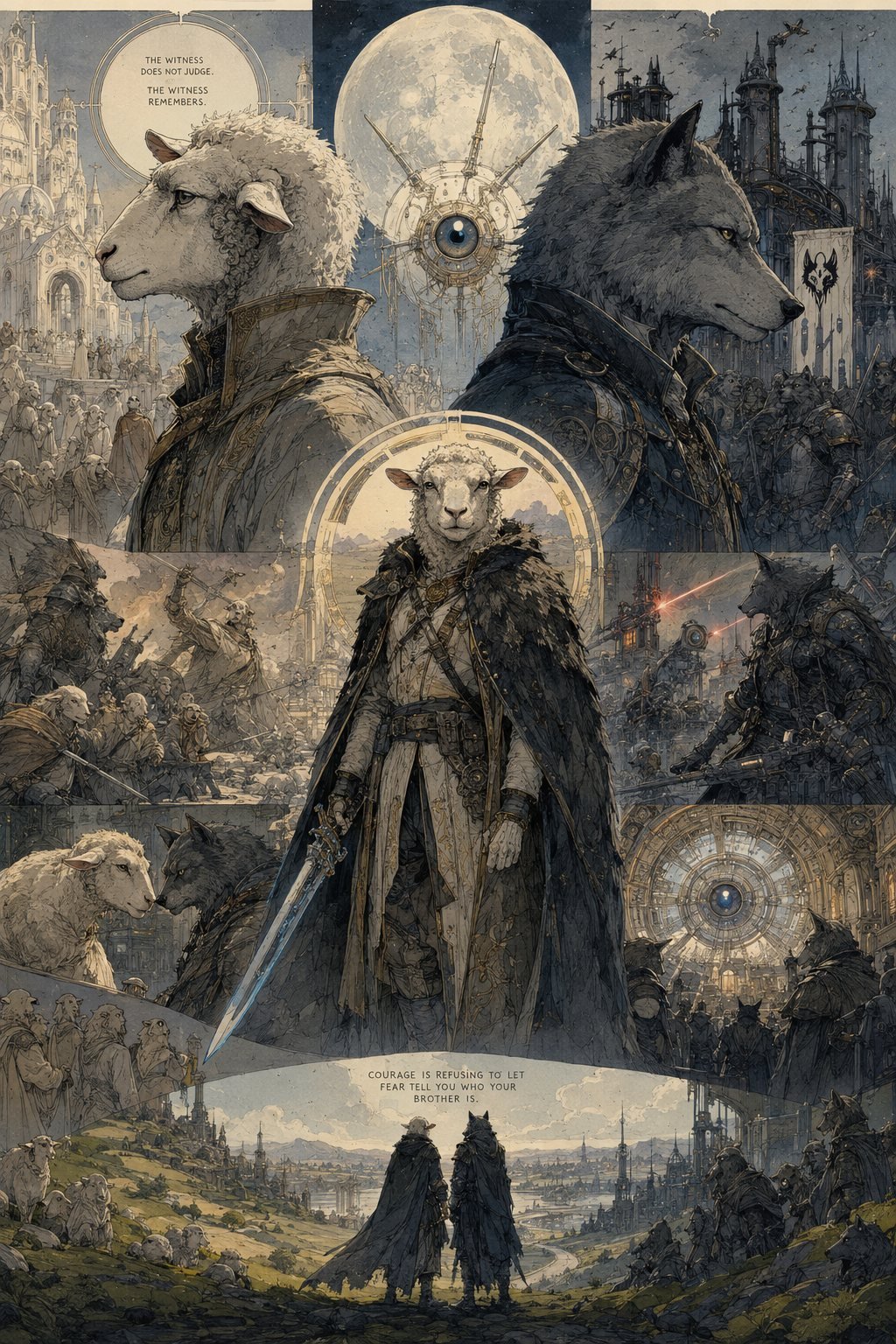
The Witness remembers.
In the age before the sky was mapped, the people of the Vale believed the Moon was an eye.
They called it The Witness.
Every night it watched the hills, the temples, the machines buried beneath the earth, and the little white sheep who gathered beneath the bells of their ancestral sanctuary.
Among them lived a young shepherd named Aurel.
He was born with the face of a sheep and the soul of a question.
His people had taught him that the Wolves were evil.
Not metaphorically evil.
Not misunderstood.
Evil.
The Wolves lived beyond the northern mountains in enormous black cities of iron, glass, and bone. Their priests wore mechanical crowns. Their soldiers rode machines that moved like insects. Their banners carried the image of an open jaw swallowing the moon.
Every generation, the sheep told the same story:
The Wolves hunger for us.
And every generation, the sheep built another wall.
But Aurel had never been satisfied with walls.
IThe Question
◆
As a child, Aurel would climb the bell tower and stare toward the Wolf territories.
He could see their distant lights flickering beneath the mountains.
Sometimes he wondered why the lights looked beautiful.
He prayed about it.
The answer never came.
He prayed harder.
Still nothing.
Eventually his priest told him:
Faith means accepting what you cannot see.
Aurel looked at the enormous mechanical telescope mounted behind the altar.
“Then why,” he asked, “did our ancestors build a machine to see farther?”
The priest struck him.
That night, Aurel stopped asking questions aloud.
But he never stopped asking them.
IIThe Wolf
◆
When Aurel was twenty-three, the northern wall fell.
The Wolves came through beneath a blood-red moon.
The sheep fled.
Aurel fought beside the soldiers, carrying an antique ceremonial blade whose edge had been replaced with a humming filament of blue energy.
He killed three Wolves.
Then he saw the fourth.
It was a young Wolf.
Barely older than himself.
The Wolf had dropped his weapon.
He was wounded.
And around his neck was the same symbol Aurel wore:
A small silver eye.
Aurel lowered his blade.
“Where did you get that?”
The Wolf stared at him.
“Where did you get yours?”
Neither understood.
IIIBeyond the Wall
◆
The Wolf’s name was Rhun.
He told Aurel that the Wolves had their own story.
According to them, the sheep had once betrayed the world.
The sheep had built the first machines.
The sheep had imprisoned the Moon.
The sheep had poisoned the rivers.
The Wolves had been created to stop them.
Aurel laughed when he heard it.
Then Rhun showed him the archives.
They descended beneath the Wolf city into a cathedral-sized chamber filled with ancient machines.
There were statues of sheep.
Thousands of them.
Not prisoners.
Kings.
Scientists.
Engineers.
Priests.
Explorers.
And at the center of the chamber stood a machine shaped like a gigantic eye.
Its inscription was written in the oldest language of both peoples.
Aurel translated it.
His hands began to shake.
The Witness remembers.
Then the machine activated.
The Moon appeared above them.
But it wasn’t the Moon.
It was a vast artificial sphere orbiting the planet, ancient beyond memory, its surface covered in luminous circuits.
Aurel fell to his knees.
His religion had not been a lie.
It had simply been incomplete.
IVThe Sheep Who Became a Wolf
◆
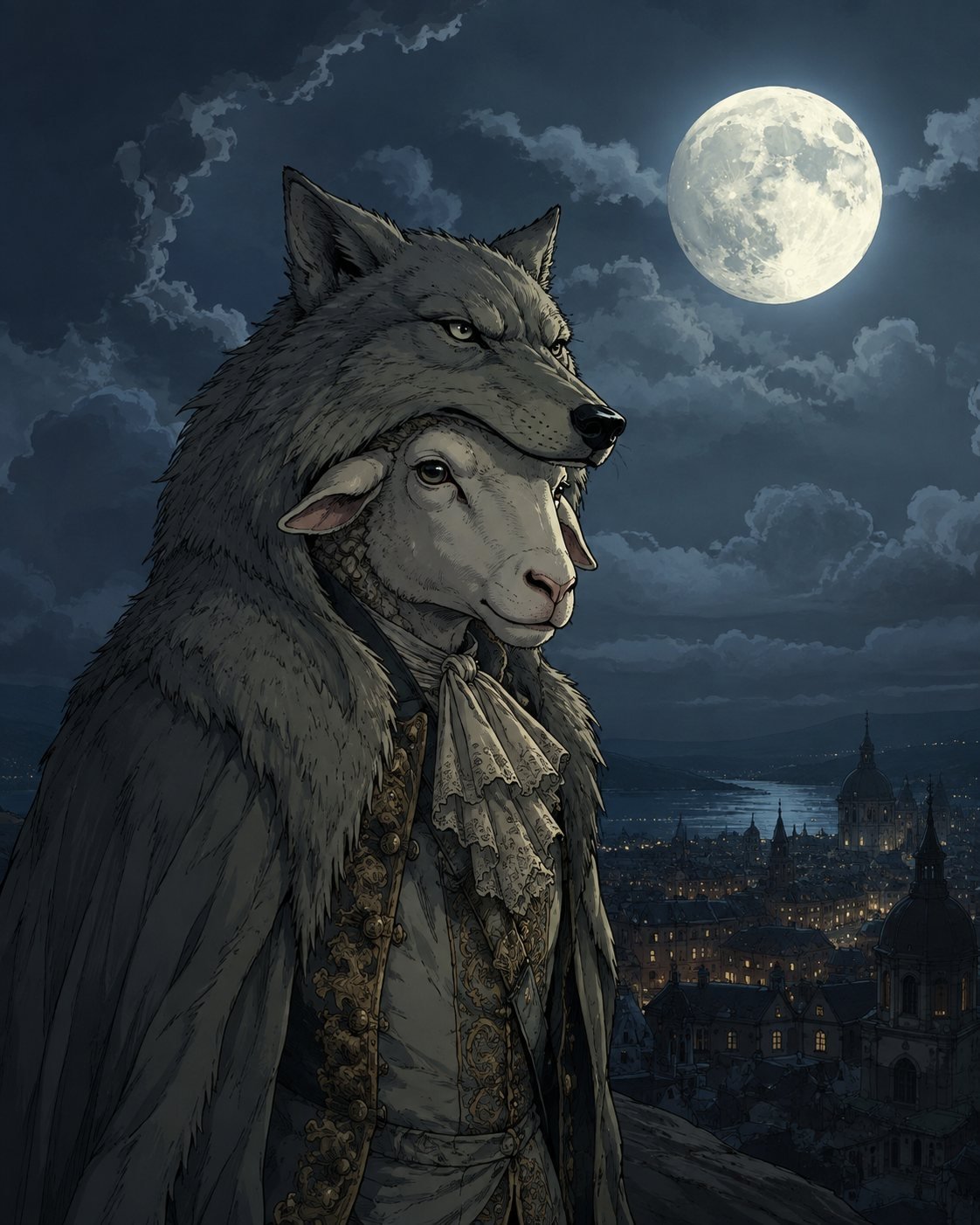
Aurel stayed among the Wolves.
He learned their language.
He learned their machines.
He learned their prayers.
And, slowly, he learned that the Wolves were not monsters.
Some were cruel.
Some were frightened.
Some genuinely hated the sheep.
But most had simply inherited a story.
The same story the sheep had inherited.
Fear had become tradition.
Tradition had become religion.
Religion had become government.
And government had become war.
Aurel began wearing the Wolf’s cloak.
The first time he returned home, the sheep screamed.
His mother wept.
The priests called him corrupted.
His childhood friends pointed weapons at him.
“You have become one of them.”
Aurel looked down at the black wolfskin draped over his shoulders.
“No,” he said.
“I have become one of you.”
VThe False God
◆
The war intensified.
But Aurel discovered something worse.
Neither side was controlling the war anymore.
The ancient lunar machine was.
It had been built to maintain balance between the two civilizations.
Whenever peace lasted too long, it altered memories.
Whenever one civilization grew too powerful, it awakened the other.
The Wolves were not the enemy.
The Sheep were not the enemy.
that required an enemy.
The priests of both nations knew.
And they protected the secret.
Because without the war, their temples would empty.
Their armies would disappear.
Their kings would lose their crowns.
Their machines would become unnecessary.
The entire civilization had been constructed around a lie.
VIThe Sermon
◆
Aurel returned to the Vale during the Festival of the Full Moon.
Thousands of sheep gathered beneath the ancient cathedral.
The priests stood upon the golden stairs.
The Wolf army waited beyond the valley.
Everyone expected blood.
Instead, Aurel climbed the altar.
He removed his Wolf cloak.
Then he removed his ceremonial robes.
Beneath them he wore neither uniform nor armor.
Only simple white cloth.
He looked like every other sheep.
And every Wolf looked like every other frightened creature.
Aurel raised his face toward the Moon.
“I prayed for an answer.”
The crowd became silent.
“I thought God had abandoned us.”
He pointed toward the sky.
“But perhaps God was never supposed to answer.”
The Moon’s machinery began to glow.
“Perhaps we were supposed to answer each other.”
The priests ordered the soldiers to fire.
No one moved.
Aurel continued.
“They told us the Wolves were hungry.”
He looked toward Rhun.
“They were.”
Then he looked at his own people.
“So were we.”
The Wolf king stepped forward.
“So what happens now?” he asked.
Aurel smiled sadly.
“Now we find out who we are without the hunger.”
VIIThe Last Wolf
◆
The lunar machine began to descend.
Its ancient systems had detected the end of the conflict.
It prepared to erase the memories of both peoples again.
Aurel understood.
Peace was not enough.
They had to remember.
So he climbed into the machine.
The interior was impossibly vast — a baroque labyrinth of golden circuitry, stained glass, rotating rings, mechanical angels, and enormous translucent organs pulsing with blue light.
At the center was the Witness.
It spoke without sound.
Forget.
Aurel closed his eyes. “No.”
Forget the pain.
“No.”
Forget the war.
“No.”
Forget the dead.
Aurel opened his eyes. “Never.”
He placed his hand against the machine.
“Let them remember everything.”
The machine screamed.
Across the world, every sheep and every Wolf suddenly remembered.
The wars.
The betrayals.
The massacres.
The friendships.
The marriages.
The children.
The moments when someone from the other side had saved them.
For the first time, the two peoples remembered the same history.
Not two histories.
One.
VIIIThe Shepherd
◆
Years later, there were no more sheep armies.
There were no more Wolf armies.
The northern wall became a road.
The temples became schools.
The war machines became bridges.
And the great lunar machine remained above them.
Not as a god.
Not as a judge.
As a monument.
Aurel became an old sheep.
Children of both peoples called him The Shepherd of Wolves.
He disliked the title.
One evening, a young Wolf asked him:
“Were you ever afraid?”
Aurel laughed.
“Every day.”
“Then why did you keep going?”
The old sheep looked toward the Moon.
“Because courage isn’t the absence of fear.”
He paused.
tell you who your brother is.
Above them, the Moon turned slowly through the stars.
And for the first time in thousands of years, it was only a moon.
Not a god.
Not a weapon.
Not an eye.
Just a beautiful white light hanging over a world that had finally decided to remember.
And somewhere beneath it, a sheep wearing a wolf’s cloak walked home.